
IROS 2026 · Accepted

When to Personalize Household Object Search: A Rigidity-Gated Hybrid Policy

Xianyao Li, Yuhai Wang, Hu Xiao, Kaleb Smith, Gilbert Yang Ye, Eric Jing Du

University of Florida · ICIC Lab

scroll
PerSim
01 · Motivation

In every home,
small things go missing

A mug gets left in the bedroom. A phone slips between the couch cushions. Keys end up somewhere unexpected.

When we ask a home robot to fetch something, it shouldn't scan every room, one by one. It should look where the object is likely to be. That is what spatial priors give us.

vs
02 · The Dilemma

But whose home is it?

Object locations are not decided by room semantics alone — mugs near kitchens, towels near bathrooms. They are also shaped by the person who lives there. Some residents always return things to fixed storage. Others tolerate clutter, and move things around all day.

This creates a real dilemma. If the robot personalizes too aggressively, it overfits noise. If it never personalizes, it wastes a real opportunity to search faster.

α
03 · The Question

So we ask one focused question:
when should a robot personalize?

To answer it, we need two things that don't exist yet: placement data that actually depends on who the resident is — and evidence from real people about where personalization genuinely helps.

PerSim builds both. Three quick steps.

04 · Our Approach

The whole system, on one slide

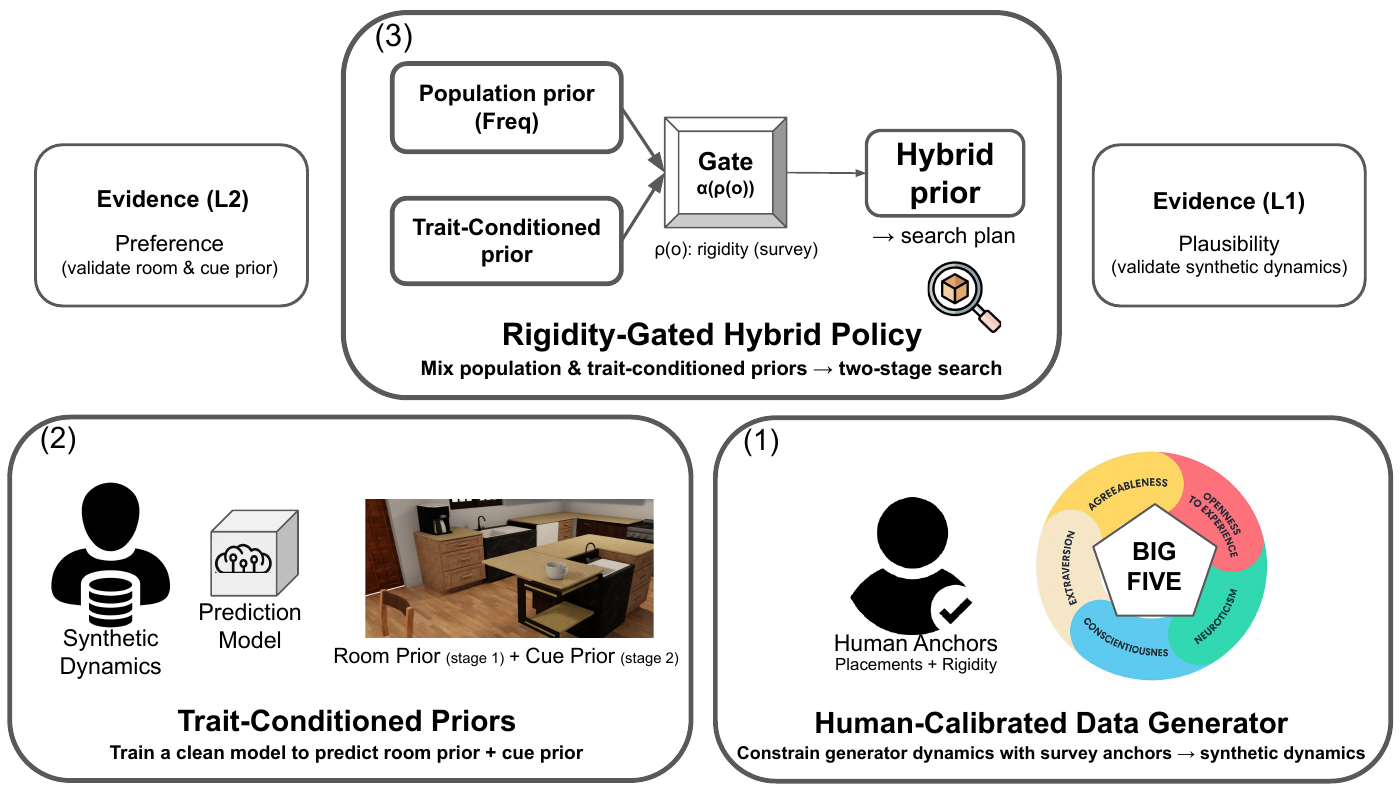
Here is the full pipeline — ground the generator in real human data, simulate personality-driven daily life, then search through a rigidity gate. Let me walk through it, step by step.
PerSim overall framework
The PerSim framework: calibrated LLM simulation → trait-conditioned priors → rigidity-gated hybrid search.
O C E A N
05 · Step 0 · A Common Language

First, we fix how to describe
a person: the Big Five

Before touching any data, we choose a common language for personality: the Big Five — psychology's standard model: Openness, Conscientiousness, Extraversion, Agreeableness, and Neuroticism. Five numbers, one habit profile.

This one choice structures everything downstream: it's the questionnaire we give real people, and it's the profile we give every simulated persona. And traits really do shape placement — high conscientiousness returns things to storage; high neuroticism keeps the phone within arm's reach.

06 · Step 1 · Start with People

Why simulate at all?
Real-world data is hard to get

The data we need — months of object movements, tied to personality, inside private homes — is invasive to collect, expensive, and hard to scale. That's the real bottleneck, and that's why we generate it instead.

But not from nothing. In round one of our human study, people gave us what they can give in minutes: a Big Five questionnaire, plus anchors — where they actually keep their things. We fine-tuned our generator LLM on those answers, so the simulation is calibrated to real behavior before it produces a single trajectory.

×14 days
07 · Step 2 · Simulate at Scale

Persona → layout →
trajectories

The calibrated generator role-plays a cast of personas. For each one, it first lays out a personalized home — where this personality keeps things by default. Then it simulates day after day of routine: objects moving through the home, each placement keeping its relations to the objects around it.

27,976
validated placement trajectories
08 · From Data to a Predictor

Now we can learn a
trait-conditioned prior

On this data we train a predictor: give it a resident's personality profile and an object, and it ranks where that object is likely to be, for that person.

Its natural competitor is simple population statistics — where most people keep things. So, the obvious next question: which one do real people actually trust?

09 · Round 2 · Layer 1

Is the synthetic behavior
believable?

Now, round two of the human study: validation, in two layers, with two hundred participants. Layer one asks — is the generated behavior plausible? Judging blind, participants rated our placement transitions 3.85 out of 5, a reliable result under our power analysis.

The claim here is deliberately modest: to human eyes, the synthetic behavior is plausible. That's the foundation everything else stands on.

A B
10 · Round 2 · Layer 2

Do people prefer
the personalized predictions?

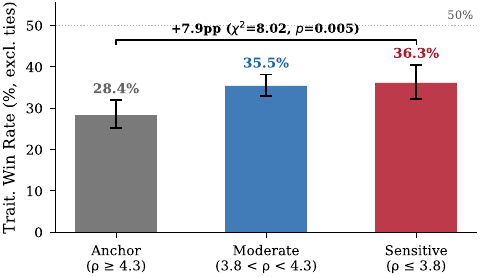
Layer two is a blinded A/B comparison: our predictor's trait-conditioned suggestions against plain population statistics. Participants did prefer personalization — but mainly for objects whose placement varies from person to person. For universally placed items, the population answer held its ground.

This gradient is not a side result — it points directly to the decision rule.
Preference for personalization vs placement rigidity
Preference for the trait-conditioned prior concentrates on low-rigidity objects.
11 · Placement Rigidity

From the study, every object
gets a rigidity score

This is the property that organizes everything. A toothbrush lives in the bathroom — in anyone's home. A cell phone rests wherever its owner last sat. The study lets us measure this, object by object.

High rigidity — everyone agrees

Universally placed. Population statistics already tell you where to look.

toothbrushdish soappillow

Low rigidity — it depends on you

Placement varies with the resident. This is where traits pay off.

cell phonewater bottlenotebook
12 · The Policy

One gate,
two priors, two stages

At search time the policy is simple. For each object, the gate asks one question: is this the kind of thing everyone places the same way — or the kind that follows its owner? The more personal the object, the more the search leans on the trait-conditioned prior. The more universal, the more it leans on the population prior.

Then the search runs in two stages: rank the rooms, go to the best one, and check the cues inside — the objects it usually sits next to.

query"find the mug"
rigidity gatepopulation ↔ trait
stage 1rank rooms
stage 2check cues
13 · Results

Personalize selectively,
win overall

We test everything end-to-end in a home digital twin — and the one-line summary is: the gated policy finds things with less search effort than either pure strategy, and the savings come precisely from the objects where personalization should help.

−12.0%
search cost on low-rigidity objects
−7.8%
search cost across all objects
200
participants behind the evidence
14 · Toward an Interface

An interface we envision

Building on this research, we also want human–robot interaction to feel this natural: you ask, the system understands who you are. This is a working demonstration of that idea — I pick an object, the gate selects the prior, ranks the rooms, and the robot runs the two-stage search on the floor plan.

Resident · Big Five profile
Rigidity gate
trait ← personalhybriduniversal → population
choose an object, then press Search
> PerSim search console — ready.
15 · The Human Study, Live

This is what our 200 participants saw

And this is not a screenshot — it's the actual survey instrument, running live inside this page. Participants gave their Big Five profile and judged placement behaviors, exactly like this.

16 · An Open Model

A model you can play with

On top of the paper, we also fine-tuned an open-weights model — Gemma 12B — on our human-calibrated data, and released it publicly. We host it as a webchat on our lab server: ask it about a persona, and it reasons about where that person would leave their things.

persim-gemma-12b · example exchange
This resident is high in Neuroticism, low in Conscientiousness. It's 9 pm — where is their cell phone?
persim-gemma-12bMost likely on the bedside table — this persona keeps the phone within reach and charges it overnight. Second guess: wedged in the living-room sofa, where they were last sitting.
Illustrative exchange. The live system runs on our lab network and is available during in-person demos.
17 · Takeaway

Personalization is not
a yes-or-no choice. It's a gate.

Give every object a rigidity score. Trust the population prior where everyone agrees. Trust the resident's traits where habits diverge. And you search faster than either strategy alone.

Thank you.